Edible Oil Refining System
Model: Custom (1-100 T/D)
Specifications
Recommended Oil Seeds
These seeds are particularly recommended for this machine model. However, it can also process most other oil seeds with excellent results. Contact us if you have questions about a specific seed.
Description
Overview
The Haonuo Edible Oil Refining System is a fully customizable refining solution designed to transform crude (raw) oil into high-quality, market-ready RBD oil. Impurities in crude oil — including gossypol, phospholipids, proteins, sugars, mucilaginous substances, metals, and moisture — not only reduce edible value and compromise safe storage, but also create serious difficulties for deep processing. This system removes harmful impurities while preserving beneficial components such as tocopherols (vitamin E) and sterols.
Available in capacities from 1 to 100 tons per day, our refining system scientifically combines mechanical, chemical, and physical-chemical methods to achieve optimal refining efficiency. Every system is engineered to order, ensuring the process flow, equipment selection, and automation level match your specific crude oil type and product requirements.
Key Advantages
- Fully customizable capacity — from 1 T/D pilot systems to 100 T/D industrial plants
- Scientific multi-method approach — mechanical, chemical, and physical-chemical methods combined for maximum efficiency
- Complete process coverage — degumming through deodorization in one integrated system
- Impurity removal with nutrient retention — removes harmful substances while preserving tocopherols, sterols, and other beneficial components
- Factory-direct engineering — custom-designed, manufactured, and installed by Haonuo without middleman costs
- Turnkey delivery — from process design and equipment manufacturing to installation, commissioning, and operator training
Refining Methods
Our system integrates three categories of refining methods for scientifically optimized results:
Mechanical Methods
Physical removal of solid impurities and suspended particles:
- Settlement (sedimentation) — gravity separation of heavy impurities
- Filtration — solid particle removal through filter media
- Centrifugal separation — high-speed separation of immiscible phases
Chemical Methods
Chemical reactions to remove free fatty acids, pigments, and undesirable components:
- Acid refining — phospholipid precipitation and metal chelation
- Alkali refining (neutralization) — free fatty acid neutralization into soapstock
- Oxidation-reduction — color body and peroxide removal
- Esterification — fatty acid recombination for improved oil properties
Physical-Chemical Methods
Combined physical and chemical principles for targeted impurity removal:
- Hydration (degumming) — phospholipid removal via water addition
- Adsorption (bleaching) — pigment and residual impurity removal via activated clay/carbon
- Steam distillation (deodorization) — volatile odor and flavor compound removal
- Liquid-liquid extraction — selective component separation
- Freeze crystallization (winterization) — wax and high-melting-point triglyceride removal
Note: Alkali refining is a chemical method, but the resulting soapstock physically adsorbs additional impurities — a physical-chemical effect. Oil-soap separation via gravity settling or centrifuge is a mechanical method. Only by scientifically combining all three method categories can refining efficiency be maximized.
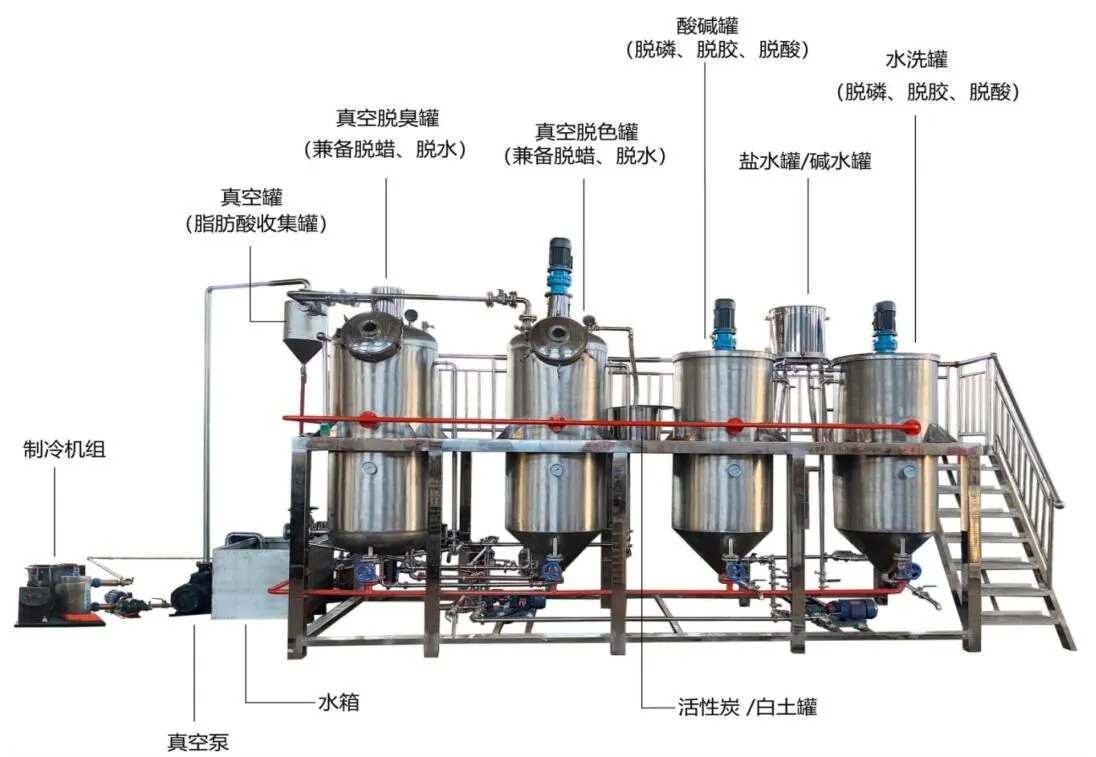
Process Flow
- Crude Oil → 2. Degumming → 3. Neutralization (Deacidification) → 4. Washing → 5. Drying → 6. Bleaching → 7. Deodorization → 8. RBD Finished Oil
Why Choose Haonuo
- Factory-direct engineering — custom-designed and manufactured without distributor markup
- Decades of refining expertise — proven process designs for all major crude oil types
- Turnkey project delivery — from process engineering to installation, commissioning, and training
- Scalable solutions — start small and expand as your market grows; modular design supports future capacity increases
- Ongoing technical support — process optimization, troubleshooting, and spare parts supply for the life of your plant